
Happy Feet Penguins - Antarctica 2026
Conquering the White Continent - Part 2

It's my last day in South America. I started in Sao Paulo, Brazil in mid-November. Travel through Brazil, Argentina, Antarctica, and Chile. I'm now at the top part of Chile in San Pedro de Atacama. I had lunch in my favorite restaurant and the couple next to me asked "Where are you from". My standard answer is NYC. They are from Philly. We spent the next few hours chatting about home and my travels and I promised to catch up on my blog. So here I am. Hope you are reading.
In the last blog, I wrote about how I ended up in Antarctica, my love of animals especially marine mammals. During grad school, I volunteered in the education department in the New England Aquarium located in Boston. I spent part of my time giving Penguin talks to the visitors of the aquarium. The aquarium houses three species of Northern penguins, the Rockhopper, African Penguin and the Little Blue.
Penguin Species


Banded penguins include the African, Humboldt and Galapagos. They are sometimes also known as "jack-ass penguins" due to their loud locator-calls sounding similar to a donkeys braying. Common traits include a band of black that runs around their bodies bordering their black dorsal coloring, black beaks with a small vertical white band. All members of this genus lay eggs and raise their young in nests situated in burrows or in natural depressions. They are also the most northern of the Penguins, rarely seen in the Antarctic waters.

Crested penguins include the Rockhopper and Macaroni are notable for their unique physical characteristics, setting them apart from other penguin species. All species have a black back and white belly, typical of penguins, but are distinguished by their vivid yellow crests. Adapted to life in cold waters, they have a streamlined body for efficient swimming, strong flippers for propulsion, and dense waterproof feathers for insulation. They are generally found in the subantarctic waters. We were blessed to see a lone Macaroni penguin on one of the islands.

Brushtail penguins include the three main Antarctica Peninsula penguins - the Gentoo, Adelie and Chinstrap. Named for their stiff brush like tail feathers. They have hydroponic fathers with the densest plumage that help to spread oil around their plumage to help with the sub-freezing water temperatures. Pupils expand to 350x underwater with nictitating membranes around their eyes to use as googles.
It's practically impossible to look at a penguin and feel angry.
Penguins of Antarctica Peninsular

Adelie Penguins quickly became our favorite. Hopping and gliding along the snow. They are the most endangered since they rely on packed ice to survive and return to the same breeding grounds to lay eggs. They also return to the same partner. Incubation time is roughly 40-60 days. There are currently 300,000 pairs left. Without the packed ice, they will starve. They dive into the waters to feed on krill and reach the furthest south of any other penguin species. They are easily identified by their distinctive white eye ring.
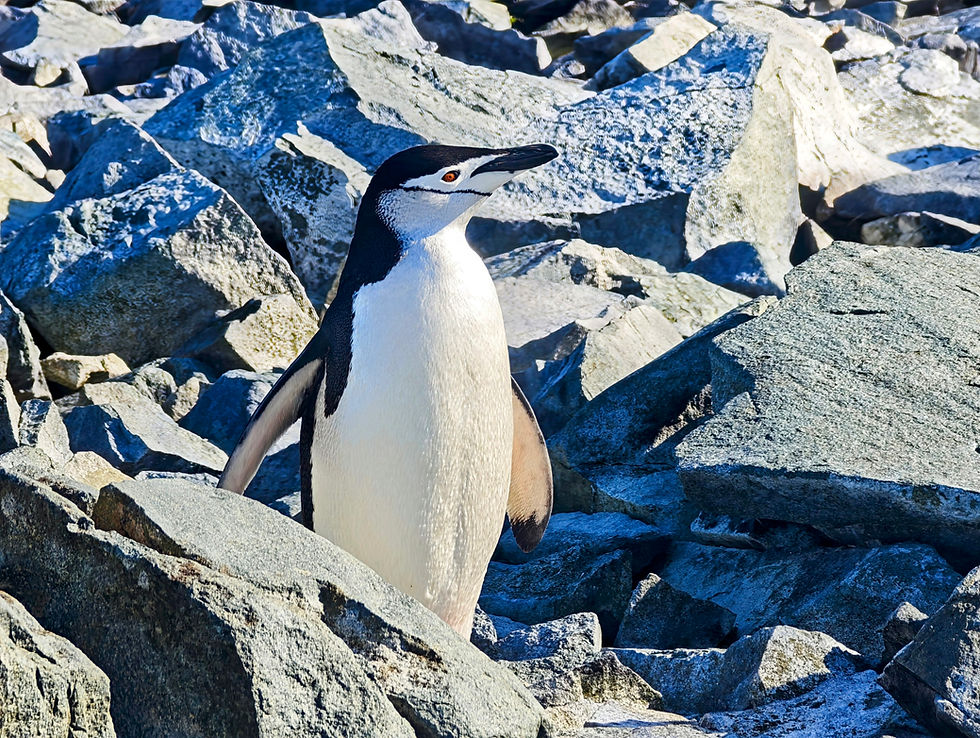
You will find Chinstrap Penguins on
rocky outcroppings on the peninsular. The signature feature is the thin black chinstrap line under the head. Breed in extremely large colonies. Chicks fledge in March losing there down feathers. There are approximately 3.4 million pairs. Highly agile and fast. Diet includes krill, fish and squid.

The most common penguin we saw on the cruise were the Gentoos. They have very distinctive bright orange-red bills and white patches above the eyes. They are the largest population of brushtail and can be found all over Sub Antarctic waters. They congregate in smaller colonies and eat krill or fish. They nest on sandy, grassy areas and chicks fledge in March. While Adelie penguins are declining due to climate change. Gentoos are thriving since they can adapt to a variety of conditions.

You may be asking about the two most famous penguin species. Well Emperor penguins are generally found further south ion stable sea ice including the Wendell Sea, Ross Sea and Snow Hill Island. The King Penguin are found further north generally around the S. George and Falkland Islands. Occasionally a lone King Penguin will make its way south to the upper Peninsula. We were lucky to find a male blending in with Chinstraps and Gentoos.
Thanks to my friends for providing the below video.
I will leave you with this photo the ship Photographer, Nacho took


Great blog post! I learned so much about penguins!